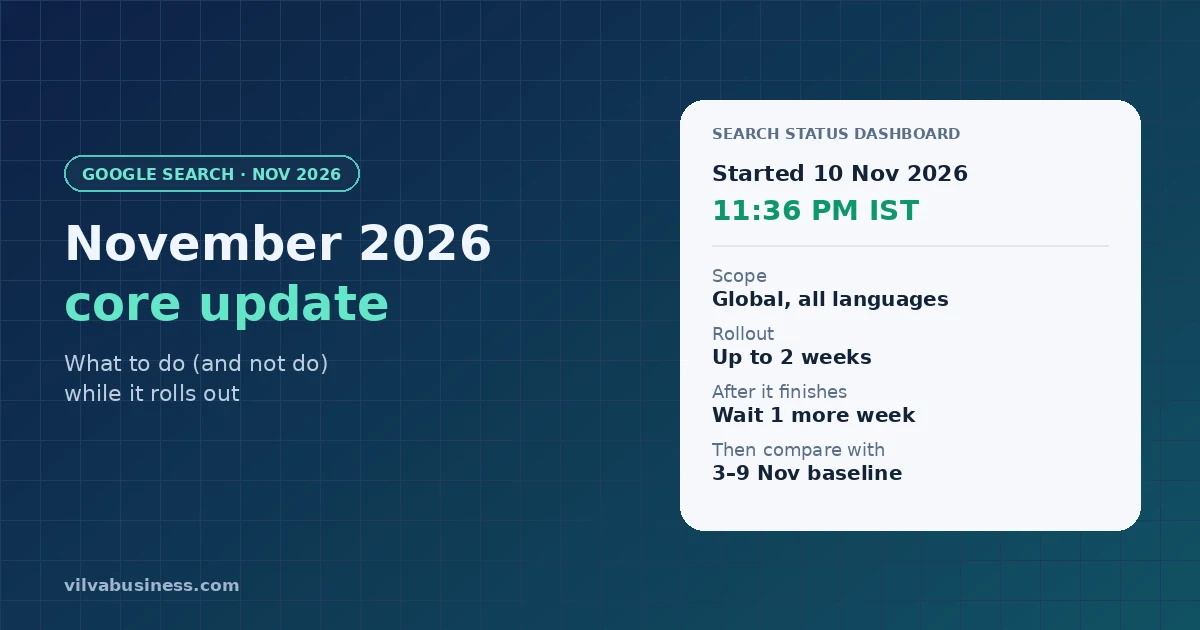
Last updated: 11 Nov 2026, 12:08 PM IST. Based on Google's Search Status Dashboard (incident started 10 November 2026, 10:06 AM PST / 11:36 PM IST) and Google's published core update guidance. The rollout is still in progress.
Short answer: Google started a global core update late on 10 November 2026. It applies to all languages and may take up to two weeks to finish. Do not rewrite or prune pages because rankings moved during the rollout. Export a Search Console baseline for 3–9 November, annotate your reports, and wait until Google says the update is done — then wait a full week more — before you compare. If the rollout takes the full two weeks, the earliest fair check is around 1 December. A drop is not, by itself, a reason to assume something is wrong with your site, and Google does not offer a specific fix.
What Google announced
On 10 November 2026 at 10:06 AM Pacific Standard Time (11:36 PM IST the same day), Google's Search Status Dashboard recorded the start of the November 2026 core update. The dashboard entry, posted a minute later at 10:07 AM PST, reads: "Released the November 2026 core update, which applies globally and to all languages. The rollout may take up to 2 weeks to complete."
Google's Search Central account also posted on LinkedIn, as reported by Search Engine Journal and Search Engine Land: "This is a regular update designed to better surface relevant, satisfying content for searchers from all types of sites."
This is the third core update of 2026, after the March 2026 core update (27 March to 8 April) and the May 2026 core update (21 May to 2 June). Those dates come from the same Search Status Dashboard ranking history. Other 2026 ranking events on that list — including the February Discover update and several spam updates — are not core updates.
Google's core update documentation says these changes are broad and "don't target specific sites or individual web pages." Rankings can still move while the update is rolling out, which is why the next two weeks are a time to record data, not to react to every daily swing.
What to do (and not do) while it rolls out
- Note the start date. The update began on 10 November 2026 at 11:36 PM IST. Write that date into your SEO notes so later comparisons use the same starting point.
- Export a 3–9 November Search Console baseline. Export clicks, impressions, average position and click-through rate for 3–9 November, by page and by query. That is the week immediately before the update started, which is the comparison window Google recommends. If you also look at Web, Image, Video or News results, export those separately — Google asks you to analyse different search types on their own.
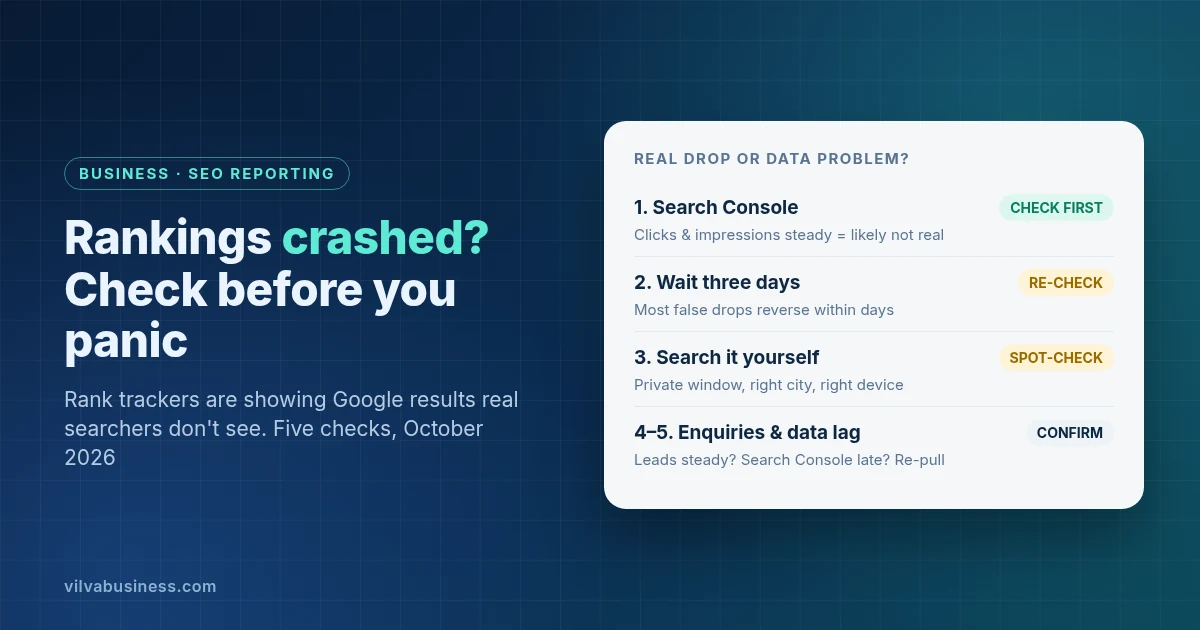
- Annotate your reports. Add a 10 November note in Search Console, your rank-tracker and GA4, labelled as a core update in progress. That stops a later report from treating a mid-rollout dip as an unexplained crash. Our post on how to check whether a reported ranking drop is real is worth re-reading if a dashboard turns red this month.
- Wait until the rollout ends, then wait seven more days. Do not judge the update from day-to-day movements while it is still running. Google recommends waiting at least a full week after the core update has finished, then comparing that week with a week before 10 November. Check the Search Status Dashboard for the official end date rather than assuming it will be exactly two weeks.
- Compare by page and by query. Look at which pages and queries gained or lost, and whether the move is small or large. Google's own examples: a small drop (for example, position 2 to 4) is not a reason to take drastic action, and Google recommends avoiding changes to content that is already performing well. A large drop (for example, position 4 to 29) is a reason for a deeper look — after the waiting period, not during the rollout.
- Review the pages that dropped. For a sustained, large drop, Google points you to its helpful, reliable, people-first self-assessment, applied to the site as a whole and to the pages that moved most. Ask whether those pages still answer the query clearly, and whether your name, service and location facts are consistent. Technical issues can also hold a page back; our guide to technical SEO mistakes that stop Indian SME sites ranking covers the basics to check. Planned fixes already on the calendar can continue, but log their dates so they are not mistaken for update effects.
What not to do is as important. Do not rewrite, merge or delete pages because a rank tracker moved during the rollout. Google advises against "quick fix" changes and against drastic edits after a small drop. Deleting content, in Google's words, is a last resort, and only if the content cannot be salvaged.
When can you fairly judge the impact?
Google has not published an end date. It has said the rollout may take up to two weeks. If it uses the full window, it would finish around 24 November 2026, and the earliest fair comparison — a full week after that — would start around 1 December. Treat those dates as an estimate from the "up to two weeks" wording, not as a schedule Google has confirmed. Use the dashboard's end date when it appears.
Search Engine Journal also notes that the week after 24 November includes US Thanksgiving, Black Friday and Cyber Monday, which can distort a comparison for sites with US holiday traffic. For an Indian business, the practical point is the same: if you ran a sale or a seasonal push in early or late November, say so in your notes and do not treat those weeks as interchangeable.
If pages have still dropped after the fair check
Google does not offer a specific action that undoes a core update. A negative rankings impact may not mean anything is wrong with your pages. Google's documentation says improvements can take effect in a few days, or it can take several months for its systems to learn that a site is now producing helpful, reliable, people-first content. If it has been a few months with no effect, "that could mean waiting until the next core update." There is no guarantee that changes you make will produce a noticeable change in results. This is also why SEO work is measured in months, not days — as our post on why SEO often takes three to six months in India explains.
Frequently asked questions
How long does the November 2026 core update take?
Up to two weeks, according to Google's Search Status Dashboard. The official start was 10 November 2026 at 10:06 AM PST (11:36 PM IST). Google will update the dashboard when the rollout is complete. Do not treat day-to-day ranking changes during the rollout as the final result.
Should I change my site during the update?
Do not make drastic edits because of a small drop, and do not rewrite pages that are already performing well. Google also advises against quick-fix changes. Planned technical or content work can continue if it was already scheduled; record the dates. Wait until the rollout has finished and a further week has passed before you judge impact.
Can I recover?
Google says there is no specific fix for a core update. Improvements you make may take days or months to show, and they may be more visible at the next core update. There is no guarantee of a recovery. A drop does not automatically mean your pages are of poor quality.
Need a calm reading of your Search Console data after the update?
Vilva's digital marketing work includes SEO reporting and audits through GrowthOS. Contact us if you want a page-and-query comparison once Google has marked this update complete and a fair week of data is in. We will not pretend to know how any site, including our own, has been affected while the rollout is still running. Vilva Business (Vilva Networks) is based in Kodungaiyur, Chennai.